Latest update: 7 September 2026 - 5 min read
HMRC mileage allowance 2026
Announced May 21 2026, backdated to 6 April 2026: HM Revenue & Customs (HMRC) has announced that the business mileage rate for the 2026/27 tax year will increase to 55p/mile for the first 10,000 miles (was 45p) and 25p thereafter (unchanged) for cars and vans, 24p per mile for motorcycles, and 20p per mile for bicycles (unchanged).
| Vehicle type | First 10,000 miles | Over 10,000 miles |
| Cars & vans | 55p | 25p |
| Motorcycles | 24p | 24p |
| Bicycles | 20p | 20p |
The above HMRC mileage rates apply from 6 April 2026 - 5 April 2027. Read further on the HMRC official website.
HMRC mileage rates, also known as Approved Mileage Allowance Payments (AMAPs) can be used by employers to reimburse employees tax-free for business travel using their own vehicles. These rates also matter if you’re self-employed and claiming mileage relief on your tax return.
Why the mileage rates matter
- The 2026 mileage allowance represents the highest amount you can pay your employees tax-free for business travel in their own vehicles (also known as grey fleet)
- If your employer pays less than the approved mileage rate, you can claim Mileage Allowance Relief from HMRC on the difference.
- If you’re self-employed, you can use these rates under the simplified expenses method to claim business mileage on your tax return.
What does the HMRC-approved mileage allowance cover?
The 10p increase is the first time the HMRC mileage allowance rate has changed since 2011. The increase was announced as an aid to those who drive for work and are facing higher costs of living and petrol in the UK. The mileage rate is supposed to reflect the economy and average costs of running and maintaining a vehicle, such as:
- Fuel
- Servicing and maintenance
- Insurance and tax
- Depreciation
That means you don’t need to separately claim these costs if you’re using the HMRC mileage rate – they’re already part of it.
How to apply the mileage allowance in 2026-2027
The way you use the HMRC mileage rate to either reimburse mileage or claim payments will depend on your employment type. We’ve broken down the most important differences you should be aware of below.
As an employer
As an employer, you can reimburse any business driving your employees conduct using personal vehicles with the mileage rates, also known as Approved Mileage Allowance Payments (AMAPs):
- 55p per mile (first 10,000 miles)
- 25p per mile (over 10,000 miles)
Although it’s not mandatory, it’s common practice to reimburse work-related travel with a mileage allowance. You can also pay an additional 5p per mile per passenger, if your employees carpool for work purposes.
If you pay at or below HMRC rates:
- Payments are tax-free
- No National Insurance contributions (NICs)
- No need to report on P11D
If you pay below the official mileage rates or choose not to reimburse mileage at all, your employees can still claim Mileage Allowance Relief (MAR) on their tax return.
Note: If you pay above HMRC rates, the excess amount must be treated as taxable income and is subject to NICs.
Check whether your employee holds another job inside your group. HMRC treats employments as associated when the employer is the same, when one employer controls the other, or when the two are associated companies, and it adds the business mileage together when working out the 10,000-mile threshold. Pay 55p on the first 10,000 combined miles rather than 10,000 per job, or the excess becomes taxable pay.
Mileage log requirements for employers
To make your mileage documentation solid and audit-proof in the eyes of HMRC, you must:
- Require employees to keep detailed mileage logs (here’s what they need to contain)
- Maintain records for at least 3 years
Tip: Using a mileage tracking app helps reduce errors and admin time.
As an employee
If you use your own vehicle for business travel, there are three possible scenarios.
1. Your employer reimburses you at the HMRC mileage rate (55p / 25p)
If your employer pays the full approved mileage allowance rate (AMAP), the payments are tax-free. You don’t need to report anything to HMRC yourself.
If you drove for two unrelated employers this tax year, each employment gets its own 10,000 miles at 55p. Employments that are associated share one threshold.
2. Your employer pays less than the HMRC rate
If you’re reimbursed below the approved rate, you can claim Mileage Allowance Relief (MAR) on the difference. HMRC will then issue a tax relief based on your tax rate.
3. Your employer reimburses you at a rate higher than the HMRC rate
HMRC’s approved rates are the highest reimbursement you can receive tax-free. If you receive a higher reimbursement than the HMRC-approved mileage rates, the excess will be taxed as part of your income.
Read more: Mileage allowance for employees
As self-employed
If you’re self-employed, you can use the HMRC mileage rate under the simplified expenses method. Instead of claiming actual vehicle costs (fuel, insurance, servicing, depreciation), you track your business miles, multiply by the HMRC mileage rate, and claim the total as a business expense on your Self Assessment tax return.
Keep in mind that you cannot claim vehicle expenses on top of the mileage rate, and you must continue using the simplified expense method once you commit to it (it’s assigned to a vehicle you drive for business).
Note: Commute between your home and regular workplace does not qualify for a deduction.
Read the self-employed mileage allowance guide for more information.
HMRC company car mileage rates (Advisory Fuel Rates)
The mileage rates above apply to self-employed, or employees using their own vehicles.
If you drive for business in a company car, HMRC publishes separate Advisory Fuel Rates (AFRs) which change quarterly and vary by engine size and fuel type (also for electric or hybrid vehicles).
Your employer can apply AFRs to reimburse you for company car fuel expenses.
Recordkeeping requirements for your HMRC mileage claims
Regardless of whether you’re getting reimbursed, claiming a tax deduction, or reimbursing employees for mileage, accurate mileage logs play a critical role in the process.
HMRC requires you to keep sufficient evidence to support your mileage claims. If you cannot provide records, HMRC may reject your claim.
What records do you need?
To stay compliant, for each business journey you should log:
- Date of the trip
- Start and end locations (with full addresses and postcodes)
- Purpose of the journey (e.g., client meeting, site visit)
- Total miles travelled
Keeping records in real time significantly reduces the risk of errors and stress at tax time. But, manually tracking mileage can quickly become time-consuming, especially if you drive for work regularly.
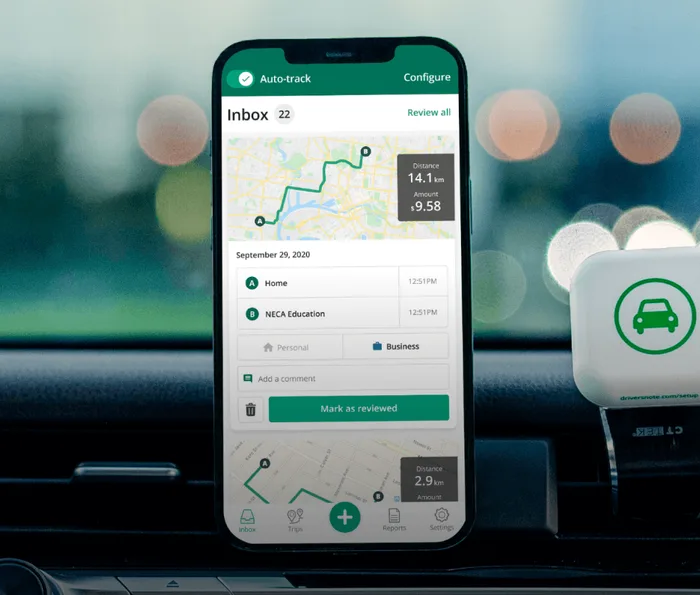
The automatic mileage tracking app by Driversnote tracks and logs business trips automatically, leaving you with mileage records that are accurate, complete, and ready if HMRC ever asks questions.
FAQ
For the 2026/27 tax year, the HMRC mileage rate is 55p per mile for the first 10,000 business miles and 25p per mile thereafter for cars and vans. Motorcycles are 24p per mile, and bicycles are 20p per mile.
Yes. The HMRC mileage rate for 2026/2027 has received a 10p increase, the first increase to the rate since 2011. The approved mileage rates are therefore 55p per mile for the first 10,000 miles and 25p after that for cars and vans (unchanged from previous years).
Business mileage includes travel to temporary workplaces, client visits, and trips between work locations. It does not include ordinary commuting between your home and your regular workplace.
Tired of logging mileage by hand?
Effortless. IRS-compliant. Liberating.
 Auto-track trips
 Classify trips
 IRS compliant reports