
Latest update: 19 August 2026 - 10 min read
Limited company expenses: what you can claim on vehicles and travel as an Ltd.
Most guides to limited company expenses hand you a list and leave you to it. That works fine for stationery. It falls apart on the biggest and most confusing category, which is your vehicle.
The allowable expenses for limited company directors depend almost entirely on one question: is the vehicle owned by the company, or by you personally?
Here’s the short version.
Note: If you’re a sole trader rather than a director, the rules differ in several important ways. Read what expenses you can claim as self-employed instead.
| Company-owned vehicle | Personally-owned vehicle | |
| What the company deducts | Actual running costs: fuel, insurance, servicing, road tax, MOT, breakdown cover, parking | Mileage paid at the approved rates, plus parking and tolls |
| What the driver pays tax on | A Benefit-in-Kind on private use, plus a fuel benefit charge if the company pays for private fuel | Nothing, as long as the payment stays at or below the approved rate |
| What the driver claims | Business fuel reimbursed at HMRC’s Advisory Fuel Rates | 55p per mile for the first 10,000 business miles, 25p after that |
The rest of this guide takes each scenario in turn, then covers capital allowances, other travel costs, records, and every other expense category your company can claim.
Scenario A: the vehicle is owned by your limited company
If the car is registered and paid for by the company, it deducts the actual cost of running the vehicle against its profits.
What your limited company can deduct
Fuel, insurance, servicing and repairs, road tax, the MOT, breakdown cover and business parking are all allowable, as is a hire car when the company vehicle is off the road. The test is whether the cost is wholly and exclusively for the business, so anything cosmetic or optional fails it. A set of alloy wheels fitted because they look good isn’t allowable, even on a car the company owns outright.
The trade-off: Benefit-in-Kind and the fuel benefit charge
Here’s the part people underestimate. If you use a company car privately, and commuting counts as private use, you pay income tax on a Benefit in Kind (BIK): a taxable value HMRC puts on having the car available to you. The company pays Class 1A National Insurance on top.
The BIK is the car’s list price multiplied by a percentage set by its CO2 emissions, so a low-emission car costs you far less than a large petrol one.
Our guide to company car tax and Benefit-in-Kind walks you through it.
If the company also pays for fuel you use privately, a separate car fuel benefit charge applies. For 2026/27 the multiplier is £29,200, multiplied by the same CO2 percentage as the car. On a 30% BIK band that’s £8,760 of taxable benefit for private fuel alone.
Reimbursing business fuel with Advisory Fuel Rates
Drive a company car on business and pay for the fuel yourself, and the company can reimburse you tax-free using HMRC’s Advisory Fuel Rates (AFR).
From 1 June 2026 these run from 14p per mile for a small petrol engine to 26p for one over 2,000cc, with 7p for a company electric car charged at home.
AFRs sit far below the 55p approved mileage rate, and that’s deliberate. They cover fuel only, because the company already bears every other cost of the car. HMRC reviews AFRs quarterly.
Treatment of vans and pickups
Vans are treated more generously: one used only for business journeys and ordinary commuting attracts no benefit charge at all. Beyond that, a flat van benefit charge of £4,170 applies for 2026/27, plus £798 if the company pays for private fuel.
Note: Double-cab pickups are the trap, as HMRC has classified most of them as cars rather than vans since 6 April 2025.
Scenario B: you own the car personally
If the car is yours, your limited company cannot deduct its running costs. Not the insurance, not the servicing, not the road tax. What it can do is pay you a tax-free mileage allowance for business journeys.
Approved Mileage Allowance Payments
Approved Mileage Allowance Payments (AMAP) are the mileage rates HMRC lets a company pay without either of you owing tax. From 6 April 2026 the approved rates are:
• Cars and vans: 55p per mile for the first 10,000 business miles in the tax year, then 25p per mile
• Motorcycles: 24p per mile at any distance
• Bicycles: 20p per mile at any distance
Pay above these rates and the excess counts as taxable earnings, reported on a P11D.
If the company pays less than 55p
That’s allowed, and the shortfall isn’t lost: you claim tax relief on the difference through Mileage Allowance Relief (MAR).
Say you drove 5,000 business miles and the company paid 30p a mile. The approved amount is £2,750 and you received £1,500, so you claim relief on the £1,250 gap.
Our Mileage Allowance Relief guide explains how.
Passenger payments
If you carry a colleague on a business journey in your own car, the company can pay you an extra 5p per mile per passenger, entirely tax-free and with nothing to report to HMRC. It’s small, it’s frequently missed, and on a regular route with two colleagues aboard it adds up quickly.
When is a journey actually business travel?
Travel from home to a permanent workplace is commuting, and commuting is never claimable. Travel to a temporary workplace is.
The dividing line is the 24-month rule. If you spend, or expect to spend, 40% or more of your working time at one site for a period lasting more than 24 months, it stops being temporary and journeys there become commuting. The clock runs on expectation, so a contract you know from the outset will last three years is a permanent workplace from day one. Our business travel guide covers the edge cases.
What does the approved mileage rate already cover?
The 55p and 25p rates aren’t a fuel allowance. They’re deemed to cover every cost of running your own car for business. If the company reimburses any of those costs separately on top of mileage, that extra payment is taxable earnings for you and liable to National Insurance for the company.
| Already covered by the 55p/25p rate | Can be reimbursed on top, tax-free |
| Fuel or electricity | Business parking |
| Insurance | Tolls |
| Servicing and repairs | Congestion charge |
| Road tax | ULEZ and clean air zone charges |
| MOT | |
| Depreciation |
The logic is simple. Parking, tolls, and congestion charges are costs of a specific business journey, so they sit outside the rate. Insurance and servicing are costs of owning the car whether you drive it for work or not, so they’re baked in. If you’ve been claiming your annual service back on top of mileage, that’s a correction worth making.
Worth noting: your company may be able to reclaim VAT on the fuel element of mileage payments. See claiming VAT on mileage.
Capital allowances on company cars
When the company buys a car, it can’t simply deduct the purchase price. Cars get their own regime.
Cars don’t qualify for the usual reliefs
Say this out loud before you buy: cars are excluded from the Annual Investment Allowance, full expensing and the super-deduction. Those reliefs cover vans, tools and equipment, not cars. Instead you claim a writing down allowance (WDA), a percentage of the remaining value each year.
The three rates
- 100% first year allowance: new and unused zero-emission cars. The full cost comes off in year one.
- Main rate pool, 14%: second-hand electric cars and cars up to 50g/km CO2. This dropped from 18% in April 2026.
- Special rate pool, 6%: cars above 50g/km CO2.
Example
Your company buys a £30,000 petrol car emitting 120g/km. That’s the special rate pool at 6%.
• Year 1: £30,000 × 6% = £1,800 claimed. Pool carries forward at £28,200.
• Year 2: £28,200 × 6% = £1,692 claimed. Pool carries forward at £26,508.
Two years in, you’ve deducted £3,492 of a £30,000 car. At the 25% corporation tax rate that’s about £873 of tax saved.
Now buy a £30,000 new electric car instead. The 100% first year allowance means the whole £30,000 comes off in year one, worth roughly £7,500 in corporation tax. That gap, plus the far lower Benefit in Kind on an electric car, is why so many directors put an EV through the company rather than a petrol car.
Whether buying or leasing makes more sense is a separate calculation and depends on cash flow, mileage and how long you’ll keep the car.
Other travel costs your company can claim
Beyond the vehicle itself, ordinary business travel is deductible.
Train, bus, air, and taxi fares are allowable when the journey is for business, and it makes no difference whether the company books them directly or you pay and reclaim. Hotel costs and reasonable subsistence on overnight business trips are allowable too, though “reasonable” is the operative word: HMRC expects proportionate spending, not a tasting menu.
Hire car costs are allowable where your own vehicle isn’t available and the trip is for work. If you hire a car while your company vehicle is being repaired, that’s straightforwardly deductible.
What isn’t claimable is just as important:
- Commuting to a permanent workplace, however far it is
- Parking fines and speeding tickets, even if you were on a business journey
- Personal journeys, or the personal leg of a mixed trip
- Travel your spouse or partner takes along for the ride
Keep receipts for all of it. Also make sure your policy is properly insured. A personal policy usually excludes business use, so check our guide to business car insurance before your first client visit.
Recordkeeping
A limited company is a separate legal person from you. That’s why your paper trail matters more than a sole trader’s: every expense you pay personally and reclaim is a transaction between two parties, and HMRC expects it to look like one.
What a compliant mileage record contains
For every business journey, log the date, the start and end point, the purpose, and the distance. That’s the minimum. Reconstructing twelve months of it from memory rarely stands up to scrutiny.
Our guide to keeping an HMRC mileage logbook sets out the requirements in full.
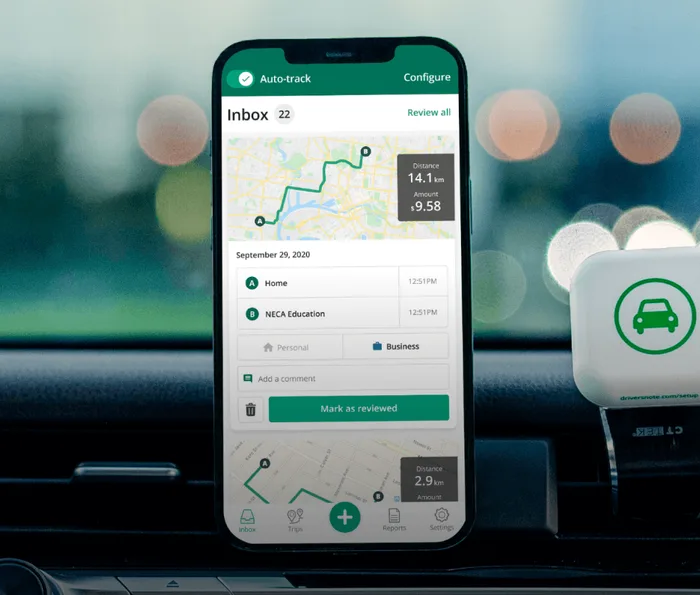
Driversnote logs trips automatically using your phone’s GPS, so distances are measured rather than estimated, and produces an HMRC-compliant report you can attach straight to a claim. Your mileage claim is only ever as good as the record behind it.
Reimbursing yourself fairly
Put a short written expense policy in place, use a simple claim form, and pay claims monthly rather than sweeping them up at year end. Monthly claims keep the company’s accounts accurate and stop you forgetting journeys.
Keep the records for six years from the end of the company financial year they relate to, as HMRC requires.
If you’d rather work from a template while you set things up, our expense tracking spreadsheet is a reasonable starting point.
Other allowable limited company expenses
Vehicles and travel are the hard part. The rest of your allowable expenses are more straightforward.
| Category | What’s typically allowable |
| Staff | Salaries, employer National Insurance, pension contributions, job-related training |
| Premises | Rent, utilities, business rates, and a proportion of household costs if you work from home |
| Equipment and software | Computers, tools, phones, subscriptions and licences used for the business |
| Professional services | Accountancy and legal fees, business insurance, bank charges and interest |
Common mistakes
Reimbursing running costs on top of approved mileage. The single most frequent error. Insurance, servicing and road tax are already inside the 55p rate. Paying them separately creates taxable earnings.
Assuming simplified expenses are available. They aren’t, they apply to sole traders and partnerships between individuals only. Limited companies and partnerships with a corporate partner are excluded.
Claiming the full cost of a car that has private use. The company can deduct the running costs, but the private benefit comes back as a Benefit in Kind on you.
Treating a commute as business travel. Home to your permanent workplace is never claimable, regardless of the distance.
Having no mileage log. Without dates, routes and distances, a claim is a number you made up. HMRC treats it that way.
\
Tired of logging mileage by hand?
Effortless. IRS-compliant. Liberating.
 Auto-track trips
 Classify trips
 IRS compliant reports