Latest update: 28 October 2026 - 5 min read
What car expenses can you claim?
It depends on how you work, what you drive and who owns it. Answer a few questions below to see how you claim, which of your journeys count, and what goes on your return, whether it’s a car, a van or a motorbike.
Self-employed car expenses work differently from an employee’s mileage claim, and a director of a limited company follows a third set of rules. Most people get stuck on the same two questions: which method they’re allowed to use, and whether the driving they do counts at all.
Note: If you drive your own vehicle for an employer, you can’t claim running costs. HMRC’s only relief is Mileage Allowance Relief (MAR). Go straight to our MAR article to find out more.
There’s also a new figure to know. HMRC raised the mileage rate for cars and vans to 55p for the first 10,000 business miles, backdated to 6 April 2026. Plenty of employers are still paying the old 45p.
Which method can you use for car expenses?
Your structure and your vehicle decide this between them, and you don’t always get a choice.
| How you work | Car or van | Motorcycle |
|---|---|---|
| Sole trader | 55p/25p flat rate or actual costs | 24p flat rate or actual costs |
| Partnership (all partners are people) | 55p/25p flat rate or actual costs | 24p flat rate or actual costs |
| Partnership with a company partner | Actual costs only | Actual costs only |
| Employee, own vehicle | Mileage Allowance Relief only | Mileage Allowance Relief only |
| Limited company director | The company claims, or pays you 55p tax-free | The company claims, or pays you 24p tax-free |
Self-employed car expenses: the 55p flat rate
If you’re a sole trader, you can use simplified expenses instead of adding up receipts. You claim 55p a mile for the first 10,000 business miles and 25p after that, or 24p a mile for a motorcycle. There’s no flat rate for bicycles when you’re self-employed.
Two rules catch people out. Once you use the flat rate for a vehicle, you stay on it until you replace that vehicle. And if you’ve already claimed capital allowances on a vehicle, the flat rate is closed to you for as long as you keep it.
More on claiming mileage allowance when you’re self-employed.
Actual costs and capital allowances
The alternative is to claim the business share of what the vehicle actually costs to run, with receipts. For a car, you claim the purchase through capital allowances, and the rate depends on its CO2 emissions.
Note: New zero-emission cars get a 100% first-year allowance until April 2027.
Actual costs usually win for an expensive car or high running costs. The flat rate is simpler and often claims more for an older or cheaper vehicle.
How much can I claim for my van if I’m self-employed?
The same as a car: 55p a mile for the first 10,000 business miles, then 25p. If you claim actual costs on the cash basis instead, you can deduct the van’s purchase price as an expense rather than through capital allowances.
Employees: Mileage Allowance Relief is the only claim
If you drive your own vehicle for an employer, you can’t claim running costs. HMRC’s only relief is Mileage Allowance Relief (MAR): the 55p rate minus whatever your employer pays you per mile. You get tax relief on that amount at your tax rate, not the full figure back in cash.
Limited company directors
Your company can pay you 55p per mile tax-free for business journeys in your own car, and you can deduct it. If the company owns the car instead, it claims the costs and you pay company car tax on the benefit.
Which journeys count as business
Even the right method gets you nothing if your journeys don’t qualify, and they need to be classed as business driving in order to do so. Employees and the self-employed follow slightly different rules.
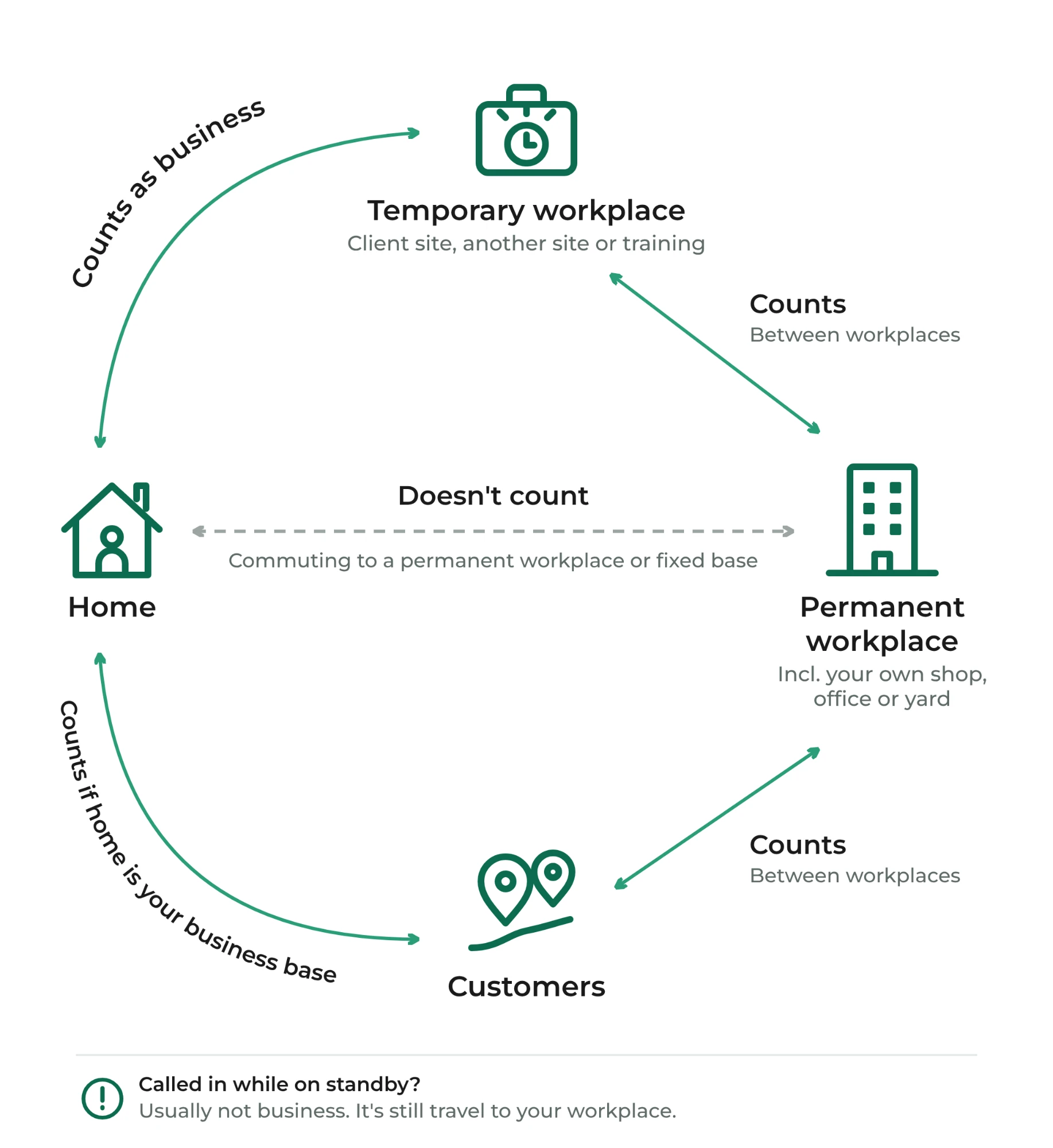
| Journey | Counts? | Why |
|---|---|---|
| Home to your permanent workplace | No | Ordinary commuting, which HMRC treats as private |
| To a client, another site or training | Yes | Travel to a temporary workplace |
| Between two workplaces in the day | Yes | Business travel |
| Home to your own shop, office or yard (self-employed) | No | Travel to a fixed base is private |
| From home as your business base to customers | Yes | Your home is where the business runs from |
| Called in while on standby | Usually not | It’s still travel to your workplace |
Temporary workplaces and the 24-month rule
A site counts as temporary until two things are both true: you expect to work there for more than 24 months, and it takes up 40% or more of your working time. Once both apply, it becomes a permanent workplace, and the trip there turns into a commute.
Does working from home make your commute claimable?
Working from home part of the week doesn’t turn your drive into the office into business travel. HMRC only treats home as a workplace when your job objectively requires you to work there, not when it’s your choice.
Here’s what counts as commute.
When home is your business base
If you’re self-employed and work at customers’ premises, with home as the base of the business, journeys from home to those customers count. If you have your own shop or yard, the drive there is private, even though you’re the boss.
What car expenses does the 55p rate cover?
The flat rate covers everything it costs to own and run the vehicle: fuel, oil, servicing, repairs, insurance, vehicle tax, MOT and depreciation. None of these can be added on top, fuel included.
What you can add is parking, tolls and congestion charges for business journeys. Parking and speeding fines are never allowable.
What records do you need?
- Employees: a log of each business journey with the date, reason, start and end postcodes and miles. You can claim online or by P87 if your total expenses claim is £2,500 or less, or through Self Assessment if it’s more. Keep records for 22 months after the tax year. Here’s how to claim it from HMRC.
- Self-employed: a record of business miles made at the time for the flat rate, or receipts and a business-private split for actual costs. Keep everything for five years after the 31 January deadline.
If your self-employed income is over £50,000, Making Tax Digital applies from April 2026, falling to £30,000 in 2027. It’s worth knowing how to keep an HMRC mileage log that holds up.
Not sure where you stand? The checker above gives you an answer in a minute or so. And if you’re self-employed, here are the other expenses you can claim.
General information based on published HMRC guidance for the 2026/27 tax year, not tax advice. Rates can change at each Budget, so check your own situation with an accountant or HMRC.
FAQ
Partly. If you're self-employed, you claim the purchase of a car through capital allowances over time, usually not all at once. The exception is a new zero-emission car, which qualifies for a 100% first-year allowance until April 2027. Vans and motorbikes can be deducted in full on the cash basis.
As a sole trader, the car stays yours and you claim the business share. With a limited company, the company can own the car and claim its costs, but you'll then pay tax on it as a benefit in kind. For many directors, keeping the car personal and having the company pay 55p a mile is simpler.
Yes. For 2026/27, you can claim Mileage Allowance Relief on the 10p a mile gap for your first 10,000 business miles. The same applies to any rate below HMRC's.
No. There's no mileage rate for a car your employer provides. You can claim business fuel you paid for and weren't paid back for. Employers often reimburse it at the advisory fuel rates instead.
A fixed allowance that doesn't depend on your mileage is taxed as pay. It doesn't count as a mileage payment, so you can still claim relief on your business miles. Here's how car allowances are taxed.
If you're self-employed or your company pays for it, yes. If you're an employee, no, but your employer can pay for it.
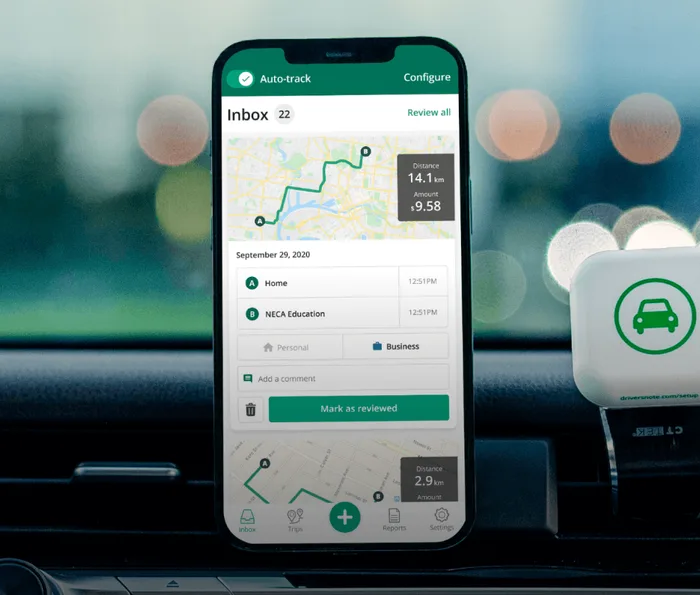
Tired of logging mileage by hand?
Effortless. IRS-compliant. Liberating.
 Auto-track trips
 Classify trips
 IRS compliant reports