Latest update: 26 May 2026 - 15 min read
How to ensure grey fleet compliance with HMRC rules
If you’re unsure what HMRC expects when it comes to tracking and documenting business mileage for your grey fleet, you’re not alone. Many employers struggle to determine which records are required, how long they should be kept, and how to clearly communicate these requirements so employees consistently follow them.
For organisations running a mixed fleet, where personal vehicles, company cars, and leased vehicles are all in use, understanding which rules apply in each scenario can be even more complex.
This guide explains HMRC’s requirements for mileage tracking and reimbursement for employers and employees across mixed fleets, including company cars, personal vehicles used for business, and leased vehicles.
| For a full breakdown of your duty of care and safety obligations under the Health and Safety at Work Act 1974, see our grey fleet risk assessment guide and checklist. This article focuses specifically on HMRC compliance. |
Read on to learn:
- Log requirements
- Record retention rules
- How compliance varies by vehicle type
- What’s at stake if documentation falls short
HMRC mileage log requirements
Note: The section below applies if you reimburse your employees for mileage.
If your employees use their personal vehicles for business travel and you reimburse their mileage, HMRC places clear responsibilities on both the employer and the employee:
- Employees must accurately record their business journeys
- Employers must retain compliant records to justify mileage payments as a business expense
- Employers must retain those records for up to six years
If records are incomplete, inconsistent, or missing, mileage reimbursements may be reclassified as taxable pay.
Any mileage reimbursed above HMRC’s Approved Mileage Allowance Payment (AMAP) rates must be treated as taxable pay and processed through payroll.
What are HMRC’s AMAP rates?
AMAPs are the tax-free rates employers can pay employees for business travel using their personal vehicles. They apply to cars and vans (with distance bands), as well as motorcycles and bicycles, and are designed to cover running costs including fuel, maintenance, and depreciation.
2026/2027 AMAP rates
| Vehicle type | First 10,000 miles | Above 10,000 miles |
| Cars and vans | 55p per mile | 25p per mile |
| Motorcycles | 24p per mile | 24p per mile |
| Bicycles | 20p per mile | 20p per mile |
Reimbursing at or below these rates means no tax or NI liability. Reimbursing above them triggers a taxable benefit.
What’s required of employees
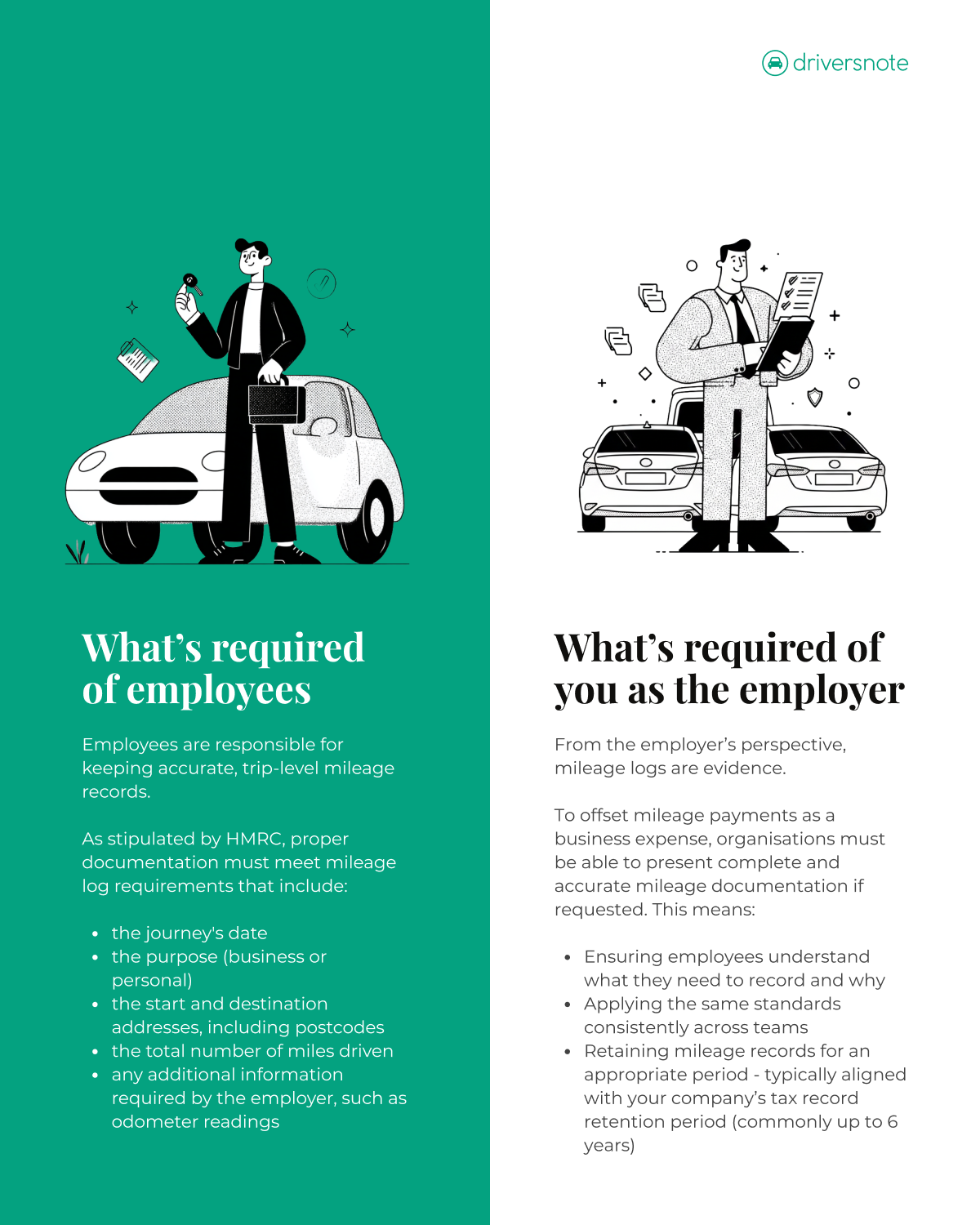
Employees are responsible for keeping accurate, trip-level mileage records. As stipulated by HMRC, proper documentation must meet mileage log requirements that include:
- The date of the journey
- If it’s personal or business-related
- The start and end points with a full address, including postcodes
- The total number of miles driven
- Any additional information required by the employer, such as odometer readings
What’s required of you as the employer
From the employer’s perspective, mileage logs are evidence.
To offset mileage payments as a business expense, organisations must be able to present complete and accurate mileage documentation if requested. This means:
- Ensuring employees understand what they need to record and why
- Applying the same standards consistently across teams
- Retaining mileage records for an appropriate period (in line with HMRC’s compliance requirements)
How long must you keep mileage records? HMRC’s guidance requires employers to keep PAYE records for at least 3 years from the end of the tax year they relate to. However, HMRC generally expects mileage logs to be retained for up to 6 years, in line with the standard limitation period for tax investigations. Keeping records for 6 years is the safer approach.
Vehicle ownership: what it means for compliance and tax
Not all business driving is treated the same. HMRC’s expectations vary depending on who owns the vehicle and how it’s provided to the employee. Clear mileage records help demonstrate that you’re applying the right treatment in each case.
1. Employee-owned vehicles (grey fleet)
In this scenario, employers typically reimburse employees for business mileage using HMRC’s AMAP rates, either as a lump-sum payment covering vehicle expenses, or at a per-mile reimbursement rate.
Mileage reimbursement is only tax-free if supported by accurate, consistent documentation. To avoid having payments reclassified as taxable, your employees must be able to show:
- Clear separation of business mileage vs. commuting or private journeys
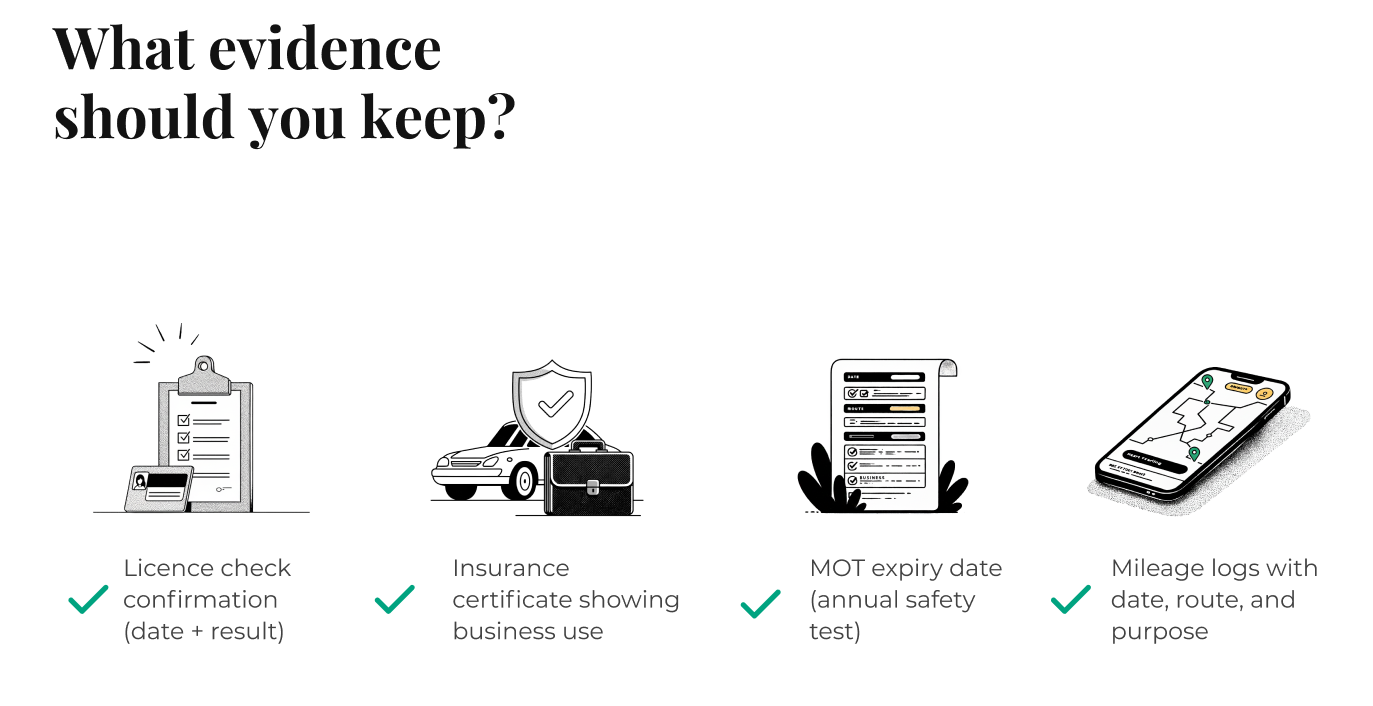
- Mileage logs showing date, route, distance, and business purpose of every journey
- Evidence that both the driver and the vehicle are eligible (valid licence, business-use insurance, MOT)
As a grey fleet employer, you have no control over the vehicles themselves, so documentation really is the only safeguard.
2. Employee-leased vehicles
Personally leased cars receive the same tax treatment as employee-owned vehicles.
Since the lease is in the employee’s name, you must confirm insurance covers business use (many personal lease policies default to private use only). Business journeys may be reimbursed using AMAPs, but records clearly documenting qualifying business journeys are required to justify tax-free treatment. Without logs, reimbursements risk being treated as taxable income.
3. Company cars
When private use is allowed
If you provide a company car as part of an employee’s benefits package, it is usually treated as a Benefit-in-Kind (BiK). This applies when the employee can use the car for private journeys, including commuting.
BiK tax is calculated based on:
- The car’s list price
- Its CO₂ emissions
- The BiK percentage set for the tax year
Accurate mileage records help demonstrate the split between business and private use and support compliance in the event of an HMRC audit.
When private use is not permitted
If private use is not allowed, a BiK charge may not apply, provided you can prove it. HMRC requires you to prohibit private use and ensure employees follow the rule. Accurate mileage records help demonstrate compliance, support your policy, and provide evidence if reviewed.
Other reasons to track company car mileage
Beyond BiK, organisations use mileage records to:
- Reconcile fuel using advisory fuel rates
- Allocate costs to clients or departments
- Maintain a clear and consistent audit trail
Tracking mileage across all vehicle types helps ensure accuracy, consistency, and compliance, especially in mixed fleets with both company cars and grey fleet vehicles.
 Also read: HMRC Mileage Guide
The risks of poor recordkeeping
Increased audit exposure
HMRC has low tolerance for weak records. Rather than simply being a compliance gap, poor documentation tends to attract attention because it signals an underlying lack of control. The likelihood of an audit is therefore higher if an organisation already appears to lack a solid foundation.
A 2023 audit by TTC Group found a 20% compliance failure rate across grey fleet checks, with 90% of failures attributable to inadequate business-use insurance alone. Weak mileage records compound that exposure.
Reclassification as taxable pay
When mileage claims cannot be adequately supported, HMRC may decide that reimbursements do not qualify for tax relief. This risk is especially high when records look like estimates (rounded numbers), logs appear repetitive, or the split between business and personal use is vague.
Consequences can include:
- Mileage payments being treated as taxable income for the employee
- Backdated PAYE and National Insurance liabilities for the organisation
- Employer exposure for underpaid tax, not just the employee
- Triggering a wider audit
Audit fail: example scenarioYour organisation reimbursed mileage monthly using spreadsheets submitted by employees. Journey totals were recorded, but start and end locations and journey purposes were optional, so many drivers left them out. Over time, small data gaps were overlooked.When HMRC requested supporting evidence during a review, the company could not clearly show which journeys were business-related or when the records had been created. Payments originally treated as expense reimbursements were reclassified as regular income, meaning the organisation had to pay backdated tax and National Insurance, potentially across multiple employees and several years, along with possible penalties and interest.What could this cost? If 10 employees each claimed £200-£300 per month in mileage over 2 years:
|
Payroll delays and internal friction
Poor recordkeeping doesn’t just create tax risk; it creates operational chaos. Late or missing mileage claims often cause:
- Back-and-forth between employees, finance, and admins
- Delays to payroll processing
- Frustration across teams
Over time, these small issues build into ongoing inefficiency, and workarounds (such as accepting incomplete claims to keep payroll moving) further weaken compliance.
What your grey fleet compliance policy should cover
A clear policy protects the business and helps define the division of responsibilities around business driving at your organisation, ensuring employees know what documentation they should provide and how to log mileage correctly.
At a minimum, a grey fleet policy should define:
- Driver eligibility and licence requirements
- Insurance requirements (including business use)
- MOT and vehicle condition standards
- Mileage rules as dictated by HMRC (what counts as business mileage, how commuting is treated)
- Required log details (HMRC-stipulated and organisation-specific)
- Reimbursement process, approved rates, and reporting frequency
We’ve drafted a customisable grey fleet policy template you can download and tweak to match your internal processes and regulations.

How to stay compliant: manual logging vs. automated mileage tracking
The problem with manual methods
Paper logs and spreadsheets rely on employee memory, manual calculations, and consistent self-discipline. In practice, they rarely deliver all three. Drivers forget to log journeys, round up distances, or submit weeks after the fact. Admins then spend time chasing, correcting, and reconciling before payroll can close.
The result is exactly the kind of documentation HMRC flags: inconsistent, incomplete, and hard to verify.
What automated mileage tracking changes
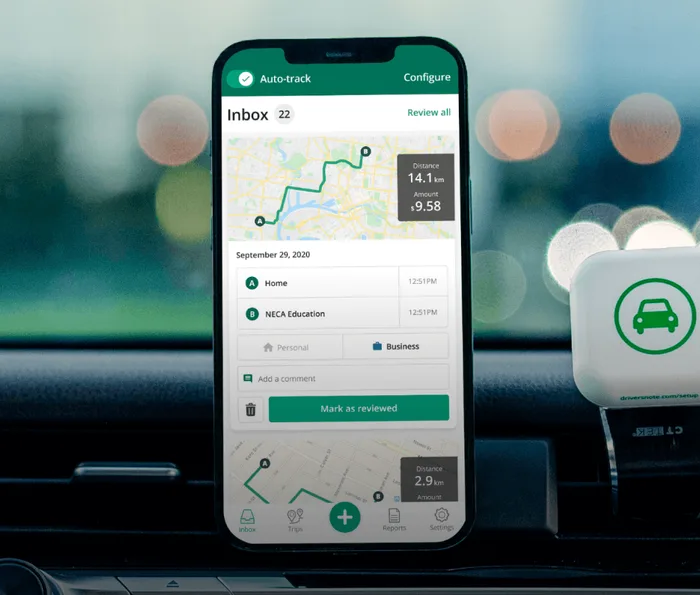
A dedicated mileage-tracking app, such as Driversnote, can automatically detect trips using your phone’s motion sensors and GPS, then let drivers classify each journey as business or personal in seconds. This removes the memory problem entirely.
| Manual logging | Automated tracking | |
| Trip detection | Driver must remember to log | Auto-detected via GPS/motion |
| Accuracy | Prone to rounding and omissions | Precise start/end addresses recorded |
| HMRC compliance | Depends on driver discipline | Structured, audit-ready documentation |
| Admin time | High (chasing, correcting, reconciling) | Lower (reports generated automatically, automatic reminders) |
| Record retention | Manual storage, easy to lose | Cloud-stored, exportable to PDF/Excel |
For employers managing grey fleets across teams, the admin difference is significant. Instead of chasing spreadsheets, finance teams receive consistent, structured mileage reports they can submit directly. Drivers spend less time on admin and are less likely to under- or over-claim or make errors that trigger a review.
Learn more about grey fleet management software and tools in our dedicated guide.
FAQ
Grey fleet legal requirements apply when employees use their own vehicles for work. Employers must: ensure drivers hold a valid driving licence, confirm the vehicle has business-use insurance, check the vehicle has a valid MOT (where required), and keep compliant mileage records if reimbursing mileage.
A grey fleet refers to employees using their own personal vehicles for business travel on behalf of their employer. The vehicles are not owned or leased by the company, but are used for work-related journeys and often reimbursed through mileage payments. Grey fleets are common in sectors such as healthcare, construction, consultancy, sales, and property management.
An employer’s duty of care for a grey fleet means they must take reasonable steps to ensure employees are safe and legally compliant when driving for work. Under UK health and safety law, employers remain responsible for work-related driving, even when employees use their own vehicles. This includes: checking licences and insurance, ensuring vehicles are roadworthy, providing a clear grey fleet policy on business driving, and managing fatigue and safe driving expectations.
Tired of logging mileage by hand?
Effortless. IRS-compliant. Liberating.
 Auto-track trips
 Classify trips
 IRS compliant reports