Latest update: 24 March 2026 - 10 min read
Grey fleet management scaling checklist: What breaks as you grow from 10 to 50+ drivers
If your business reimburses employees for using their personal cars for work, the real risk is not grey fleet itself - it is letting informal processes scale too far. What works for a handful of drivers often breaks at 10, becomes a bottleneck at 25, and creates avoidable compliance and admin risk at 50+.
The short version:
- At 10 drivers, consistency matters more than sophistication
- At 25 drivers, manual approvals and document chasing start to drag
- At 50+ drivers, you need clear ownership, audit trails, and repeatable controls
According to HSE’s employer guidance on driving and riding safely for work, employers must manage health and safety risks for people who drive for work, and that applies to both company and grey fleet vehicles. HSE also says the main areas to assess are the journey, the driver, and the vehicle. If staff use their own vehicle for work, apart from normal commuting, the duty still applies.
What changes as a grey fleet grows?
A growing grey fleet usually becomes harder to manage in three ways:
| What grows | What starts to break | What that leads to |
| Number of drivers | Mixed reporting methods | Slower approvals and more admin |
| Number of trips | Manual checking | Overpayments, estimates, duplicate claims |
| Numbers of documents | Informal reminders | Missed licence, insurance, or MOT checks |
The trigger is usually growth, not bad intent. The fix is putting the right checks and systems in place before admin, reimbursement errors, and compliance gaps pile up.
Our research with teams managing employee mileage shows a clear pattern:
“As teams grow, informal mileage processes break down — not due to bad intent, but because checks and oversight don’t scale.”
Source: Sales & Onboarding Call Analysis, 2025
Before you scale, check whether grey fleet is still the right model
Grey fleet is the right setup for many UK employers, especially when employees drive occasionally or when business travel spans office, field, and hybrid roles.
But it is worth reviewing when:
- annual business mileage per driver starts climbing
- drivers travel regularly between multiple sites
- the business needs tighter operational control
- reimbursement costs and admin time start rising together
If you are weighing up whether personal vehicles still make sense, see company car vs personal car.
At 10 drivers: replace ad hoc processes
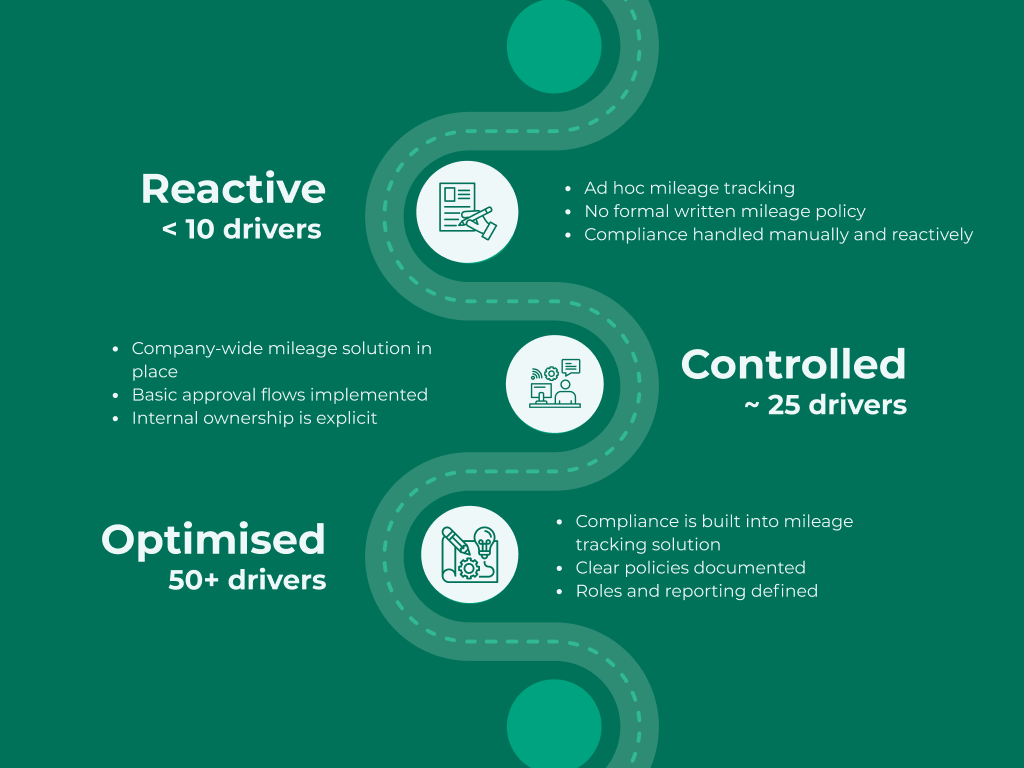
At under 10 drivers, grey fleet is typically in what you might call the reactive stage: ad hoc mileage tracking, no formal written policy, and compliance handled manually. Mileage claims arrive in different formats, approvals depend on who submitted what, and key checks often live in someone’s memory rather than a system.
This is the “hero” stage, where one person takes charge simply because someone has to. It works at small scale. It does not scale.
What to put in place
- One consistent method for logging and submitting mileage
- A named owner for licence, insurance, and MOT checks
- A simple reimbursement process with the same rules for every team
- A written policy explaining what counts as business mileage
If you’re unsure about how your organisation complies, start by using our risk assessment checklist, and keep in mind that employers are expected to manage driving-for-work risk, and that the law applies to employees using their own vehicles for work too.
If you need a policy baseline, start with a grey fleet policy template.
At 25 drivers: admin becomes the bottleneck
Around 25 drivers is the controlled stage: ownership, documentation, and automation become critical. Manual mileage management stops being efficient, and costs start to drift. Small inaccuracies, like rounded distances, missed or duplicated trips, add up across dozens of drivers. No one is acting in bad faith, but mileage inflation becomes almost inevitable without properly recorded trips.
By the time a grey fleet reaches 25 drivers, mileage administration needs to be automated, from tracking to approval.
This is echoed in our research with what drives new team administrators towards a solution like Driversnote:
“Reviewing mileage reports is consistently described by administrators as the most time-consuming part of the process, largely due to manual verification and missing or inconsistent data.”
Source: Sales & Onboarding Call Analysis, 2025
Driver documents are stored across shared inboxes, folders, and spreadsheets. Different managers check mileage and compliance in slightly different ways. Mileage claims get approved without consistent controls to flag anomalies.
Accountability becomes blurred.
That matters because weak mileage records can create tax and audit problems as well as operational friction. If you reimburse employee mileage, records need to be accurate, complete, and consistent enough to support HMRC compliance.
What to scale at this stage
- Automate mileage capture where possible: This reduces estimates, missed trips, and duplicate entries.
- Standardise approval flows: Managers should review claims the same way, using the same evidence.
- Schedule recurring document checks: A practical annual baseline is licence, business-use insurance, and MOT where applicable.
- Document who does what: If finance approves payment, managers verify journeys, and HR or operations handles eligibility, write that down.
At 50+ drivers: structure becomes non-negotiable
At 50+ drivers, grey fleet enters the optimised stage: compliance must be built into the system, not bolted on after the fact. You are no longer managing a single group of drivers. You are most likely managing multiple teams within one organisation, each with its own managers, approval flows, and reporting needs.
Your setup must support both team-level independence and central control. Without it, simple questions get hard to answer:
- Are all drivers currently insured for business use?
- Are checks being completed on time across teams?
- Can you show a clear mileage record if asked?
- Is responsibility for oversight actually defined?
At this size, informal oversight fails because the process depends on local habits rather than central controls.
As one operations manager we spoke to during our research explained:
“When you look at the expenses, people are just putting ‘I drove 200 miles’. But nobody really drives exactly 200 miles — it might be 198 or 203. At that point, you realise people are just estimating.”
Source: Sales & Onboarding Call Analysis, 2025
What good looks like at 50+ drivers
| Area | Minimum standard |
| Mileage logs and records | Automated, centralised and audit-proof |
| Driver checks | Recurring, documented, and owned |
| Approvals | Consistent across teams |
| Access control | Role-based permissions (driver, manager, finance, admin) |
| Responsibilities | Explicit, not assumed |
| Data handling | UK GDPR-compliant, privacy-first |
At this scale, access control becomes part of the compliance conversation. Role-based permissions, clear approval hierarchies, and GDPR-compliant handling of mileage and personal data are no longer optional extras. HSE’s framework remains the foundation: manage the journey, driver, and vehicle as a system, not as a series of individual admin tasks.
The checklist: signs your grey fleet process is no longer scaling
Use this as a quick self-check.
Your process likely needs attention if:
- mileage reports come in multiple formats
- managers approve claims differently across teams
- employees round journeys or estimate distances
- licence, insurance, or MOT checks rely on reminders
- records sit across inboxes, spreadsheets, and shared folders
- nobody clearly owns the end-to-end process
If several of those apply, the issue is not the size of the grey fleet alone. It is that the process has outgrown the controls around it.
👉 Get your grey fleet management scaling checklist below
The next step
Grey fleet does not suddenly become unmanageable at a fixed number of drivers. What fails is a process that never evolved beyond trust, spreadsheets, and manual checks.
If your team is growing, the safest move is to add structure early - before approvals slow down, records become patchy, and compliance becomes harder to prove.
Download the checklist (using the green buttons above), then review your current setup against each growth stage. If you need the wider framework too, start with the full grey fleet guide or compare your options in grey fleet management software and tools.
FAQ
Yes. HSE confirms that health and safety law applies to both company and grey fleet vehicles when staff drive for work.
At a minimum, most employers should verify a valid driving licence, business-use motor insurance, and MOT where required. Many organisations also keep a record of recurring review dates and vehicle details.
No. HSE says normal commuting is not generally classed as driving for work. The duty applies when employees use their own vehicle for a work-related journey beyond normal commuting.

Tired of logging mileage by hand?
Effortless. IRS-compliant. Liberating.
 Auto-track trips
 Classify trips
 IRS compliant reports