Latest update: 24 March 2026 - 10 min read
Grey fleet policy: Template and practical guide for UK employers
As long as only a few employees occasionally claim mileage, grey fleet management can feel manageable. But as your organisation grows, informal processes quickly become unclear, inconsistent, and harder to oversee.
A grey fleet policy defines ownership, sets expectations, and establishes structure. That way, you avoid small gaps turning into operational risk.
This guide is for UK HR, operations, and finance teams responsible for managing business travel who want a clear, workable grey fleet policy that people actually follow.
Do you need a grey fleet policy?
Short answer: yes - if anyone drives their own vehicle for work.
From a legal perspective, your duty of care starts the moment one employee drives for business. The Health & Safety at Work Act applies whether the vehicle is company-owned or privately owned.
From a practical perspective, a policy becomes essential as soon as:
- More than a handful of employees claim mileage
- Managers need to approve mileage regularly
- You reimburse travel through payroll or expenses
At that point, managing a grey fleet shifts from occasional admin to an ongoing process that requires clarity and consistency.
There are two thresholds to be aware of:
1. The legal threshold (5+ employees)
If your organisation employs five or more people, UK law requires you to have a written health and safety policy, and since driving is one of the highest-risk work activities, that policy must cover driving for work, including grey fleet.
2. The operational threshold (~10 drivers)
Even with fewer employees, once 10 or more people drive for work, informal processes stop scaling. This is where:
- Document checks get missed
- Approvals become trust-based
- No one is quite sure who owns what
A written policy turns assumptions into clarity.
Our own research with teams managing employee mileage highlights a common challenge as organisations grow:
“As teams grow, informal mileage processes break down — not due to bad intent, but because checks and oversight don’t scale.”
What does a good grey fleet policy include?
The most effective grey fleet policies create clarity across three areas. Here is what each one should include in practice:
| Area | What the policy should require |
| The vehicle | Valid MOT, business use insurance cover, roadworthy condition, annual document checks |
| The driver | Valid UK driving licence, declaration of penalty points or disqualifications, no driving under the influence |
| The journey | A strong policy helps employees pause and consider whether a personal vehicle is the right option in the first place. |
| The mileage tracking process | Mileage records per trip (date, purpose, start/end location, distance), reimbursement at HMRC approved rates. Standardising this removes manual work, reduces errors, and creates the visibility needed to manage all vehicles effectively. |
On insurance: this is the most commonly overlooked requirement. Standard personal car insurance does not automatically cover business use. If an employee is involved in an accident while driving for work without business use cover, the employer may face vicarious liability. Your policy should require employees to confirm their insurance includes business use before any mileage is reimbursed.
On mileage records: HMRC requires that mileage logs include the date, business purpose, and start and end locations for each journey. Without adequate records, reimbursements may be treated as taxable income.
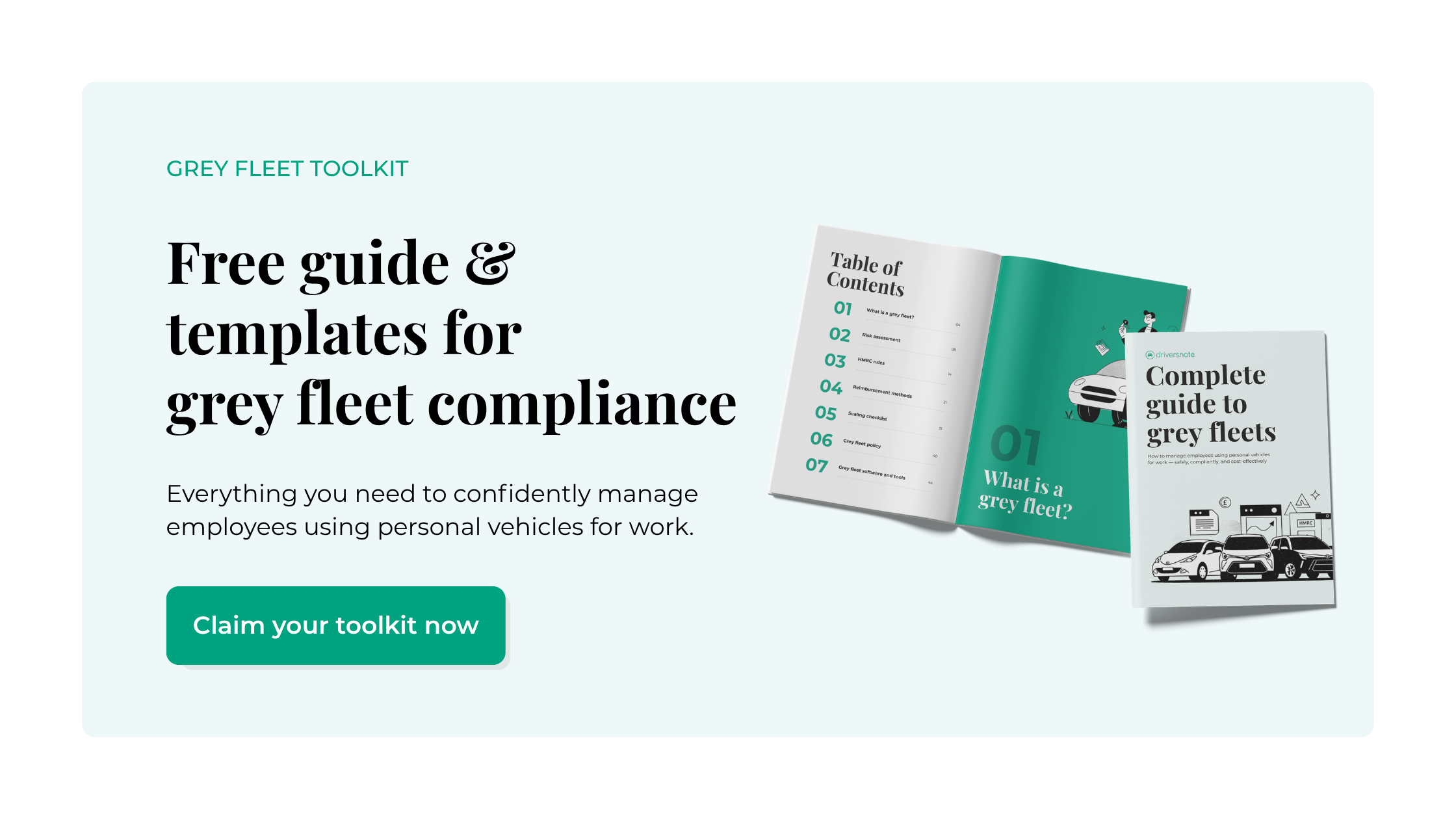
Get a free downloadable grey fleet policy template (PDF, Google Doc)
To make this easy to implement, we’ve created a free, customisable grey fleet policy template you can adapt to your organisation. It’s intended as a general reference and does not constitute legal advice or a legal agreement.
It includes:
- A ready-to-use policy structure
- Practical examples
- Implementation tips
- Review and enforcement guidance
👉 Download the grey fleet policy template
How to implement a grey fleet policy (and make it stick)
Creating a policy is one thing. Implementing it into everyday operations is another.
Successful organisations make expectations visible. The policy forms part of onboarding, is referenced in internal systems, and is easy to access. It does not disappear into folders that no one revisits.
They also make it easy to do the right thing. Clear guidance, consistent mileage submission processes, and simple reporting structures remove friction. When expectations are straightforward and supported with the right tools, compliance becomes routine rather than reactive.
Finally, they regularly review their approach. As teams grow and travel patterns change, your fleet setup and internal processes may need to evolve. Reviewing mileage data, vehicle mix, and ownership responsibilities at least annually ensures your policy continues to reflect reality rather than assumptions.
How to enforce the policy without creating admin overhead
Enforcement does not have to mean heavy monitoring. In practice, it means putting guardrails in place so the right actions happen by default.
This can include reimbursing mileage only when required documents are valid, setting reminders for expiring licences or insurance, or standardising trip reporting through a consistent system, such as Driversnote Teams. When processes are structured and transparent, oversight becomes easier without adding unnecessary complexity.
| To sum up: A grey fleet policy, when implemented well, is less about control and more about clarity. It defines who owns what, reduces friction as you scale, and ensures that growth does not quietly increase risk. |
Common grey fleet policy mistakes
Most grey fleet problems are not the result of bad intent. They are the result of gaps that were never addressed in writing.
| Mistake | Why it matters | What to do instead |
| Relying on self-declaration for insurance | Employees may not know what their policy covers | Require a physical copy or photo of the insurance certificate |
| No named owner for grey fleet compliance | Oversight falls through the cracks | Assign a named person in HR, finance, or operations |
| Reimbursing mileage without a log | Creates HMRC exposure | Require a compliant mileage log before processing any claim |
| Assuming commuting counts as business travel | It does not, under HMRC rules | Define business travel clearly in the policy |
FAQ
A grey fleet policy is a company policy that sets out the rules for employees using their own vehicles for business travel. It typically covers rules on what counts as business mileage, reimbursement rules, licence and insurance requirements, vehicle safety standards, and expectations around recordkeeping. The purpose of a grey fleet policy is to ensure tax compliance, safety, and clear expectations for both employers and employees.
UK employers have legal duties under health and safety law and tax rules. If you hire 5+ employees, you must have a written health and safety policy in place. If employees drive for work, you must take reasonable steps to ensure they are safe and legally compliant, and maintain proper records for reimbursing mileage. In practice, a written grey fleet policy is the clearest way to demonstrate compliance and duty of care.
Yes. If you reimburse employees for business mileage and want payments to be tax-free, HMRC expects accurate mileage records. Mileage logs should include: date of the journey, business purpose, start and end locations, and total miles driven. Without adequate records, HMRC may treat mileage reimbursements as taxable income.

Tired of logging mileage by hand?
Effortless. IRS-compliant. Liberating.
 Auto-track trips
 Classify trips
 IRS compliant reports