Latest update: 26 May 2026 - 10 min read
Company car vs personal car: What’s the best option for your organisation?
For most UK organisations, the answer depends on two things: annual mileage and vehicle type. At under 10,000 miles per year, reimbursing employees via HMRC’s Approved Mileage Allowance Payments (AMAPs) is almost always the cheaper option. At higher mileage, or where electric vehicles are in play, company cars can become more cost-effective.
This guide breaks down the real costs, tax implications, and compliance risks of both models so you can make the right call for your organisation.
Key takeaways
|
The two fleet models explained
Company cars involve the employer leasing or purchasing vehicles directly, covering insurance, servicing, and maintenance. The employee pays Benefit-in-Kind (BiK) tax on the vehicle’s availability for private use.
Grey fleet means employees use their own vehicles for business travel and are reimbursed per mile. The employer avoids vehicle ownership costs but takes on compliance obligations around insurance, MOTs, and duty of care.
The rise of private vehicle use by employees can indicate a shift from providing company cars as default. For some employees, having more freedom with the vehicle, as well as increased BiK rates could also be a deciding factor for switching to privately owned cars.
However, company cars remain a significant part of the UK employment landscape. HMRC data show that around 840,000 employees received a company car in 2023/24.
So, as a UK-based organisation, should you provide company cars or let your employees use their own cars for work? Or maybe provide a mix of both?
Which model suits which organisation?
| Scenario | Better fit |
| Low mileage (<10k miles/year) | Grey fleet (AMAPs) |
| High mileage (15k+ miles/year) | Company car |
| EV adoption is a priority | Company car (low BiK) |
| Small or distributed team | Grey fleet |
| Brand visibility or specific vehicle standards matter | Company car |
| Workforce prefers flexibility | Grey fleet |
Costs: Grey fleet
Mileage reimbursement using AMAPs
Under HMRC’s Approved Mileage Allowance Payments, employers can reimburse up to 55p per mile for the first 10,000 business miles per year, and 25p per mile thereafter, free of tax and National Insurance — provided mileage records are accurate and compliant.
The AMAP rate is designed to cover all vehicle running costs for the employee: fuel, wear and tear, insurance, and depreciation. For employers, the benefit is simplicity: costs scale directly with business use, and there is no fixed commitment per employee.
Tracking mileage when using the per-mile rate
What’s important is that AMAPs are designed to be tax-free, but only if you can prove to tax authorities that mileage claims are accurate, reasonable, and strictly business-related.
Capturing mileage consistently and close to the time of travel directly supports that, but it can be an added burden for the employee. Thankfully, with digital mileage tracking solutions, drivers can log miles automatically, avoiding reports based on guesswork or estimates that could trigger HMRC, and reducing the risk of inflated mileage you’ll have to cover.
Car allowance
Car allowance is a fixed monthly or annual payment (typically £300–£500/month) added to salary to help employees fund their own vehicle. It is fully taxable as income, subject to income tax and National Insurance contributions for both the employer and the employee.
It can be combined with AMAPs, but this combination is the most expensive option for employers.
| Note: If you pay no mileage reimbursement alongside a car allowance, employees can claim Mileage Allowance Relief (MAR) directly from HMRC at tax time. |
Costs: company cars
Fixed vehicle costs
When you provide a company car, you absorb the lease or purchase cost, insurance, servicing, tyres, and breakdown cover. These costs are fixed regardless of mileage — a key distinction. A car sitting mostly idle still costs you £350–£500/month in lease and maintenance.
Business fuel reimbursement via Advisory Fuel Rates
For business journeys in company cars, fuel is reimbursed using HMRC Advisory Fuel Rates (AFRs), updated quarterly by engine size and fuel type. For electric company cars, HMRC publishes a separate Advisory Electric Rate (AER) for home and public charging.
Unlike AMAPs, AFRs cover fuel only — not depreciation or maintenance — because those costs are already covered by the employer.
Read more: How to stay HMRC-compliant when managing a grey fleet
Real-world cost comparison
Same employee, three scenarios. All figures represent employer cost only.
Employee profile: Surveyor, 12,000 business miles/year, mid-size petrol car
Scenario 1: Grey fleet, AMAPs only
| Component | Calculation | Annual cost |
| Mileage reimbursement | (10,000 × £0.55) + (2,000 × £0.25) | £6,000 |
| Vehicle, insurance, maintenance | Covered by the employee | £0 |
| Total employer cost | £6,000 |
Scenario 2: Grey fleet, car allowance + AMAPs
| Component | Calculation | Annual cost |
| Car allowance | £400 × 12 | £4,800 |
| Mileage reimbursement | Same as above | £6,000 |
| Total employer cost | £9,800 |
Car allowance nearly doubles the employer cost without removing mileage spend. It’s a popular employee perk, but the financial case for the employer is weak unless mileage is tightly controlled.
Scenario 3: Company car (petrol, leased)
| Component | Calculation | Annual cost |
| Vehicle lease | £35 × 12 | £4,200 |
| Insurance & maintenance | Fixed | £1,200 |
| Business fuel (AFRs) | 12,000 × £0.15 | £1,800 |
| Total employer cost | £7,200 |
BiK tax is the employee’s obligation and is not included here.
Summary and comparison
| Model | Annual employer cost |
| AMAPs only | £6,000 |
| Company car | £7,200 |
| Car allowance + AMAPs | £10,800 |
At 12,000 miles, AMAPs win on pure employer cost. But as mileage climbs toward 16,000–20,000 miles, the fixed cost of a company car becomes more competitive — especially when fuel-only AFR reimbursement replaces the all-in AMAP rate.
Tax implications compared
Company car BiK
BiK is calculated on the vehicle’s list price, CO2 emissions, and the applicable BiK percentage for the tax year. The employee pays income tax on the benefit; the employer pays Class 1A National Insurance on the BiK value.
Key risk: BiK applies based on availability for private use, not actual mileage. A car that is nominally “business-only” but lacks documented restrictions will still trigger full BiK.
Grey fleet: AMAPs and tax efficiency
When mileage records are accurate and business journeys are clearly documented, AMAP reimbursements are tax-free for both employer and employee. There is no BiK on a personal vehicle.
Key risk: If HMRC challenges mileage claims as inaccurate or misclassified, reimbursements can be reclassified as taxable pay, triggering PAYE, employer and employee National Insurance, and potential penalties. Automatic mileage tracking software significantly reduces this risk by creating a contemporaneous, auditable record.
Car allowance
Treated as salary by HMRC — subject to income tax and National Insurance regardless of how the car is used. No mileage evidence is required for the allowance itself, but it provides no tax efficiency for either party.
How to set yourself up for success with a grey fleet
Grey fleets can be the cheaper, simpler alternative to company cars – if and when managed correctly. Start by documenting processes, assessing what your organisation needs to stay compliant, and creating transparency with a grey policy.
Mileage inflation
Mileage inflation doesn’t necessarily mean intentional fraud, as it’s often linked simply to the inaccuracy of pen-and-paper logging. But, it can lead to employees:
- Estimating or rounding up distances instead of measuring routes as they go
- Reconstructing logs, weeks later, from memory
- Taking small private detours and unintentionally including them in the business mileage
When you’re in control of the per-mile payments through systematic tracking and reporting, you can avoid the small inaccuracies that would inevitably add up and increase your annual spend.
Automate admin tasks
With an automatic solution in place when managing mileage for a grey fleet, you’ll avoid:
- Chasing drivers for missing or late mileage claims
- Reviewing journey details for accuracy and business purpose
- Correcting errors before payroll runs
- Handling resubmissions when claims are rejected
Individually, these tasks may seem minor. At scale, they become a recurring cost, especially in organisations with distributed teams or frequent short drives.
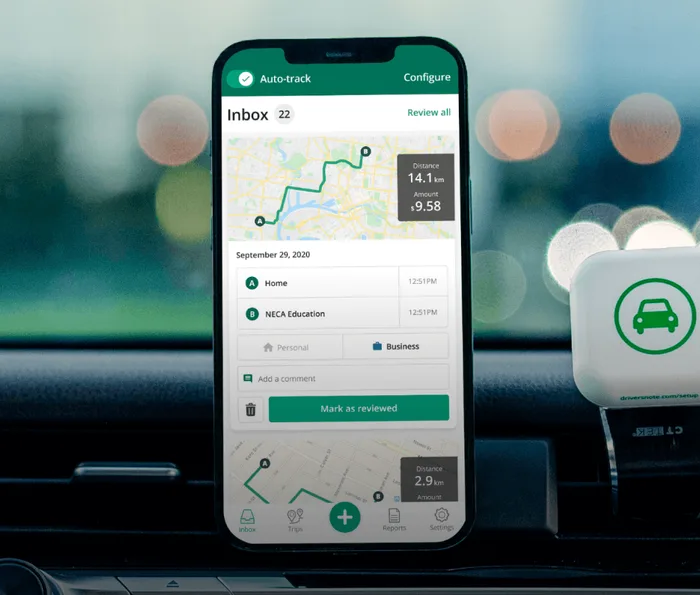
A mileage tracking app, like Driversnote Teams, can significantly reduce painstaking manual labour around tracking, logging, and reporting.
FAQ
It depends on annual mileage. For lower mileage (under 10,000 miles), reimbursing employees using HMRC mileage rates (AMAPs) is often cheaper. At higher mileage levels, company cars can become more cost-effective due to fixed leasing costs and lower per-mile fuel reimbursement rates.
A grey fleet refers to employees using their own personal vehicles for business travel. With a grey fleet, employers can reimburse mileage using HMRC Approved Mileage Allowance Payments (AMAPs) or provide a taxable car allowance.
AMAPs apply to employees using personal vehicles. Advisory Fuel Rates (AFRs) apply to company cars and cover fuel costs only. AFRs are updated quarterly and vary by fuel type and engine size.
Yes. Many organisations offer employees a choice between a company car and a cash allowance (which funds grey fleet use). Around 58% of company car schemes allow this choice, according to Income Data Research. The tax treatment differs significantly between the two options, so employees should understand the implications before choosing.
Tired of logging mileage by hand?
Effortless. IRS-compliant. Liberating.
 Auto-track trips
 Classify trips
 IRS compliant reports